Toward an AI-Native Control Plane: Wave Autoscale's Next Chapter
Author: Wave Autoscale Team
Date: March 13, 2026
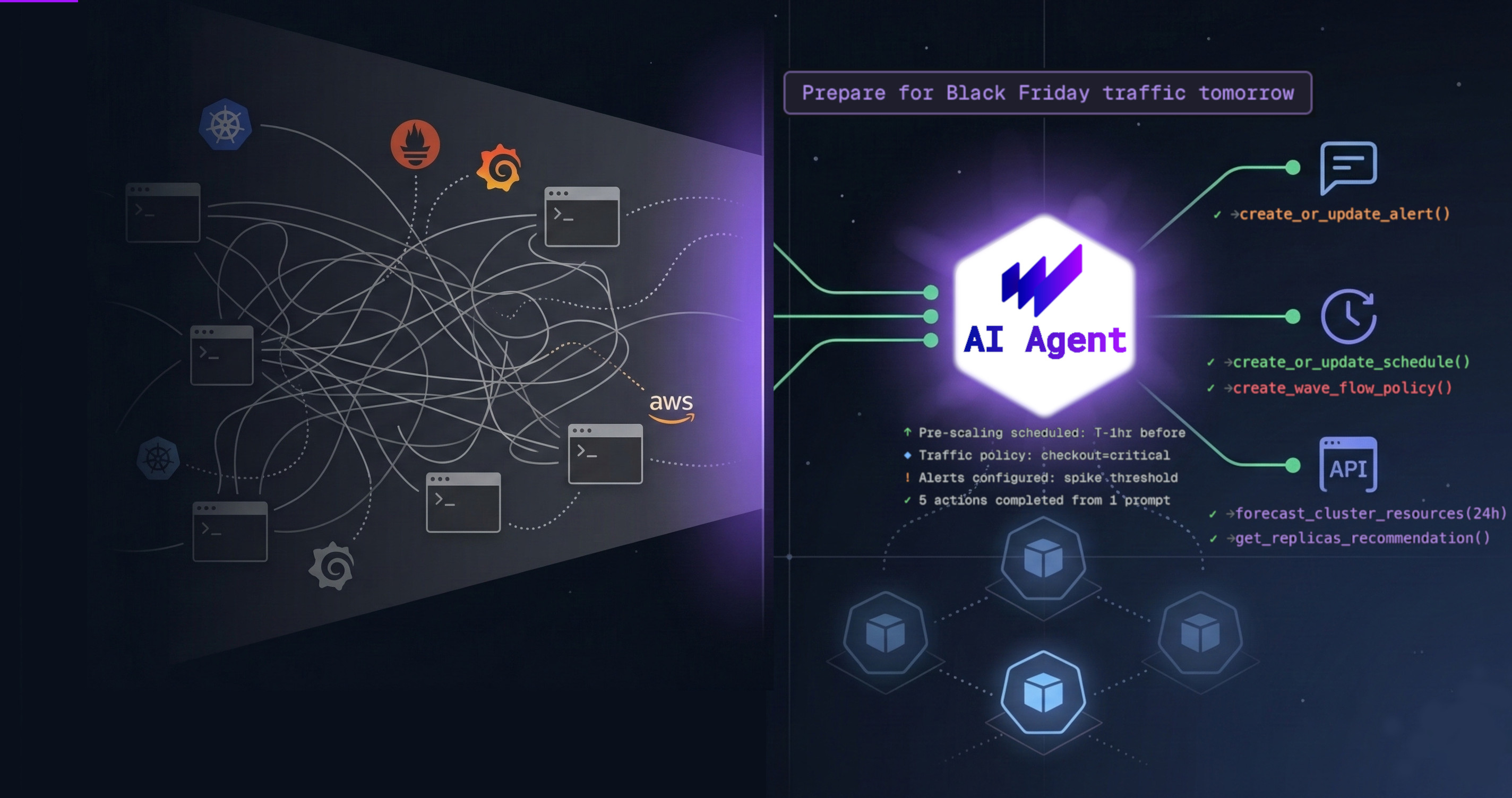
AI has transformed how we write code. 70% of code is now AI-generated, and AI-native IDEs have become the standard. But when it comes to operating the infrastructure that code runs on, most teams are still switching between terminals, dashboards, and runbooks. The gap between development AI and operations AI is widening.
Wave Autoscale started as an ML-based autoscaling engine. Now we're building something Bigger: an AI-native control plane for Kubernetes where natural language replaces fragmented toolchains, and intelligent agents handle the operational heavy lifting around the clock.
Here's what that looks like, and why it matters.
The Current Reality: Operating K8s with AI Agents Today
Teams are already experimenting with AI agents for Kubernetes operations. Tools like Claude Code, ChatGPT, and Copilot can connect to clusters via MCP servers or CLI wrappers.
In theory, you can ask an LLM to "check my cluster health" and get an answer. Blog posts on troubleshooting Kubernetes with MCP servers (opens in a new tab) and managing clusters with Claude Desktop + MCP (opens in a new tab) walk through the process in detail and they reveal just how many moving parts are involved.
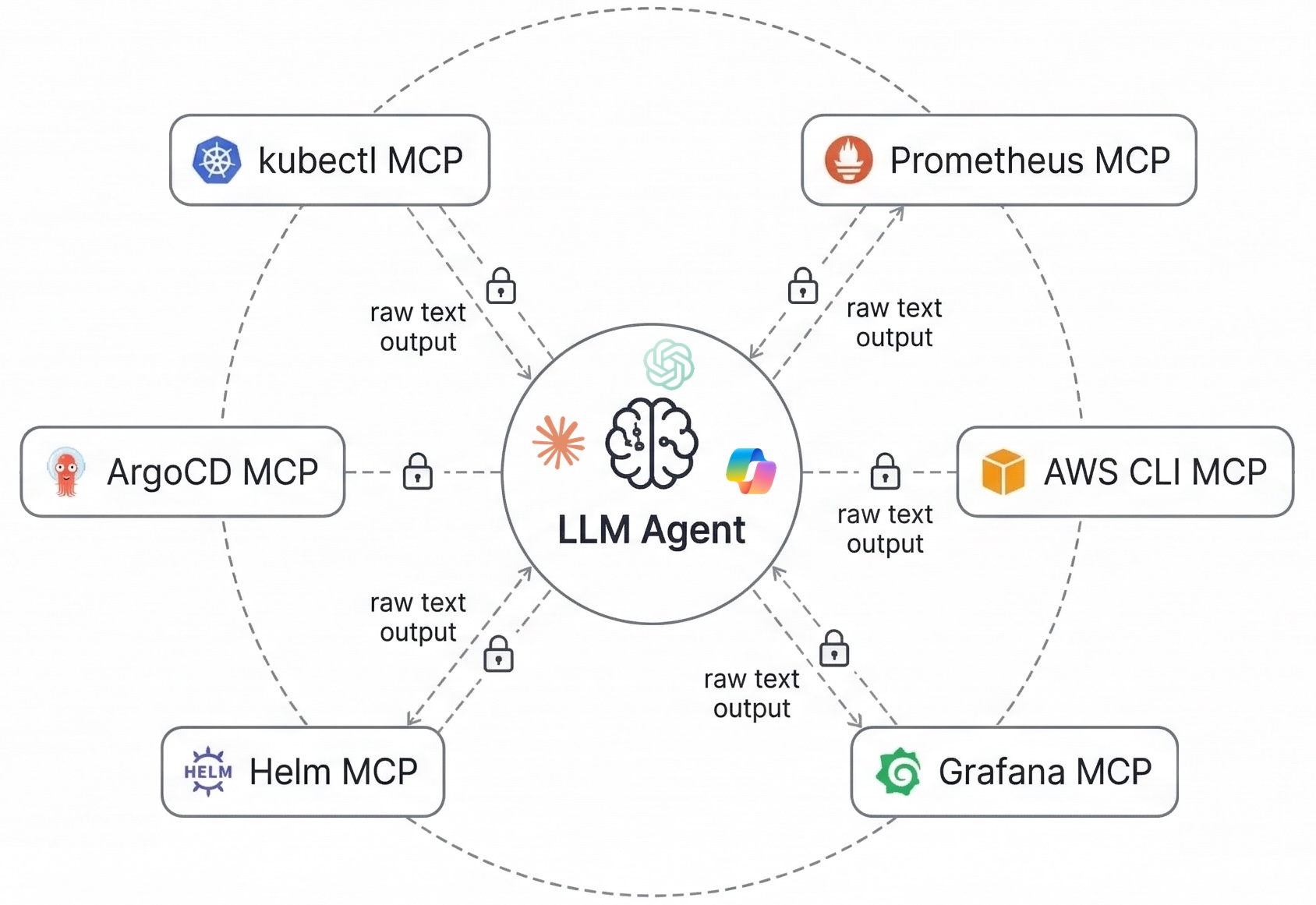
In practice, the workflow looks more like this:
-
Set up authentication for every system. Configure kubectl credentials for each cluster. Set up Prometheus endpoint access. Wire up AWS CLI credentials. Each tool connection is a separate setup step, and credentials expire or rotate. As PerfectScale's walkthrough (opens in a new tab) shows, even the K8s MCP server requires mounting
.kube/configinto Docker, and each additional provider (Prometheus, Grafana, AWS) demands its own API key configuration. -
Make multiple calls to gather raw data. To understand a single workload's resource status, the agent needs to call kubectl MCP to list nodes, call it again for
top nodes, query Prometheus with PromQL for historical metrics, check pod status, and pull EC2 cost data from AWS. That's 5-10 separate tool calls just to build context. -
Rely on the LLM to interpret raw metrics. The agent receives unstructured text output from kubectl and raw time-series data from Prometheus. It has to parse, correlate, and reason about this data with no domain-specific intelligence. The quality of the analysis depends entirely on the user's prompt and the LLM's general knowledge, which may not reflect current Kubernetes best practices. As InfoWorld noted in What ChatGPT Doesn't Say About Kubernetes in Production (opens in a new tab), when pushed beyond surface-level advice, LLMs "rely on public knowledge, which may contain inaccurate, outdated, or irrelevant information", missing production nuances like node sizing trade-offs and control plane limits that only come from hard-won operational experience.
-
Iterate through multiple rounds to take action. Once the agent has an analysis, acting on it requires more tool calls: updating a deployment config, adjusting HPA thresholds, creating alerts. Each action is a separate kubectl command with its own risk of misconfiguration. The user often needs to verify intermediate results before proceeding, turning a "quick check" into a 15-minute back-and-forth.
The result: 10-20 seconds per query, 6+ MCP servers to install and maintain, and a workflow that still requires significant human oversight. One engineer using Claude to manage a home lab cluster (opens in a new tab) with 80+ namespaces and 150+ pods put it well: Claude works as "a copilot, not an autopilot." It found issues a human might miss like operators with hundreds of restarts but every action still required human judgment and approval. It's better than pure manual operations, but it's far from the autonomous, intelligent operations that teams actually need.
The Wave Autoscale Approach: A Single Pane of Intelligence
We're building Wave AI Agent to collapse that entire workflow into something fundamentally simpler.
The key difference: Wave Autoscale is already inside your cluster. It already has credentials configured. It's already collecting metrics continuously. It already understands your workloads. So when an AI agent needs to answer a question or take an action, it doesn't start from zero, it starts from a foundation of pre-collected, pre-analyzed data.
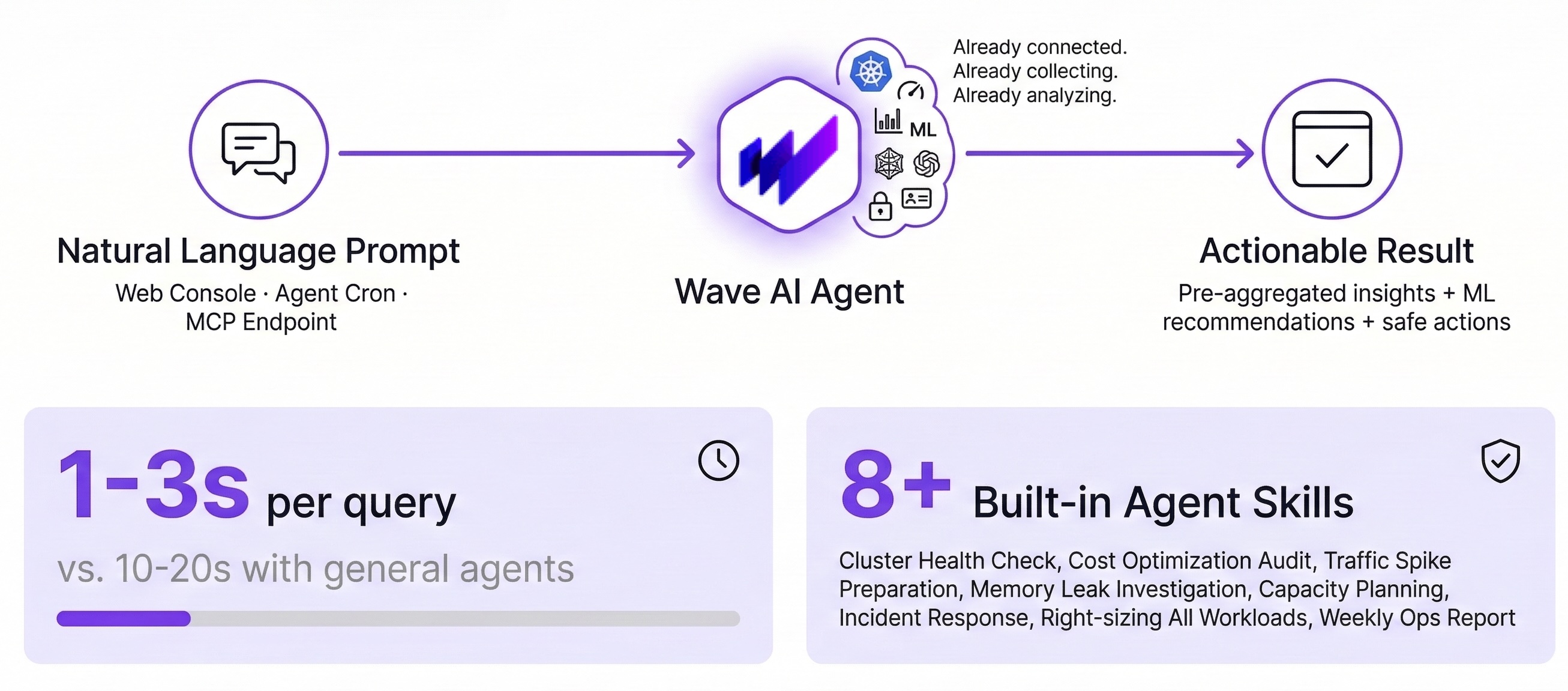
Here's what the same "check cluster health" workflow looks like with Wave AI Agent:
-
User prompts via web console, cron schedule, or MCP endpoint. No credential setup. No tool wiring. Just a natural language request.
-
Wave AI Agent calls
get_cluster_status(). One tool call. Returns pre-aggregated node, pod, and resource status with ML-powered anomaly detection, capacity forecasts, and right-sizing recommendations. Data that would have required 5-10 separate calls is already computed and waiting. -
Built-in Agent Skills apply best practices automatically. The agent doesn't depend on the user knowing the right PromQL query or the optimal HPA configuration. More than eight pre-built skills, from Cluster Health Check to Cost Optimization Audit to Incident Response. Encode EKS operational expertise directly into the agent's reasoning.
-
Actions execute through safe, API-based controls. No raw kubectl commands. Wave AI Agent uses dedicated tools with built-in confirmation flows and simulation modes, reducing the risk of misconfiguration.
The result: 1-3 seconds per query, zero per-session setup, and ML-powered insights that general-purpose agents simply can't provide.
Try it yourself click a prompt below to see what a Wave AI Agent interaction looks like:
wave-agent@prod-cluster ready
Connected to 12 nodes · 156 pods · 80 namespaces
Select a prompt:
Three Ways to Interact
Wave AI Agent won't be a single-use chatbot. We're designing three interaction modes to fit different operational patterns:
The most intuitive path. Open Wave Autoscale's UI, type a natural language prompt, and get results immediately. Examples:
- "What's the health status of the production cluster?"
- "Find workloads with memory leaks"
- "Show me cost optimization opportunities across all namespaces"
The agent has full context of your clusters, so there's no need to specify connection details or namespace filters — it already knows.

What can I help you with?
What This Unlocks: Real-World Scenarios
To make this concrete, here are two scenarios we're building toward:
One-Command Event Preparation
An operator types: "We have a Black Friday promotion tomorrow. Prepare for the traffic." Wave AI Agent automatically invokes five tools: forecasts resource demand for the next 24 hours, generates replica recommendations for key services, creates a pre-scaling cron job one hour before the promotion, sets up priority-based traffic policies (checkout = critical, search = best-effort), and configures traffic spike and error rate monitoring alerts. One sentence, five automated actions.
Automated Cost Optimization Reports
Every week, Agent Cron runs a cost optimization audit. It detects 3 idle nodes running only DaemonSets, 12 unused PVs in Released/Available state, and 23 over-provisioned workloads. It generates an executive report: current monthly cost $47,200, post-optimization estimate $31,800, projected savings $15,400 (32.6%). The report includes specific recommended actions with dollar amounts attached. Decision-makers get actionable data without anyone running a single query.
Comparison: With vs. Without Wave AI Agent
| Dimension | Without WA (General AI + MCPs) | With WA AI Agent |
|---|---|---|
| Setup | Configure kubectl, Prometheus, AWS CLI MCPs per cluster | Pre-connected; zero per-session setup |
| Data gathering | 5-10 tool calls, raw data, LLM parsing | 1-2 calls, pre-aggregated + ML insights |
| Best practices | Depends on user's prompt quality | Built-in Agent Skills (8 EKS patterns) |
| Night incidents | PagerDuty → wake engineer → manual debug | Auto-detect → auto-remediate → report |
| Scheduling | Manual or custom scripts | Agent Cron with natural language skills |
| Integration | Install & manage 6+ MCPs | 2 MCP servers expose all 50+ tools |
| Latency | 10-20 seconds per query | 1-3 seconds per query |
| Actions | Direct kubectl (risky) | Safe API with confirmation flow |
| Intelligence | Raw metrics, no ML | ML anomaly detection, capacity forecasting, predictive scaling |
| Maintenance | Update each MCP independently | Single platform, unified updates |
What's Next
This is Wave Autoscale's next chapter. We started as a scaling engine, evolved into an ML-powered autopilot, and now we're building toward a full AI-native control plane for Kubernetes operations.
Powered by Amazon Bedrock for enterprise-grade AI reasoning and the Strands Agents framework for stable agent operations, Wave AI Agent represents a shift from reactive, manual operations to proactive, autonomous intelligence. Every metric, log, and insight collected by the platform becomes foundation data for the AI Agent — making it smarter and more context-aware with every deployment.
We believe the future of Kubernetes operations isn't more dashboards or more alert rules. It's an intelligent layer that understands your clusters, anticipates problems, and acts on your behalf while keeping you in control.
We'll be sharing more details, demos, and early access opportunities in the coming weeks. Stay tuned.
Wave Autoscale is an AWS EKS Service Ready Partner. Learn more at wavek8s.com (opens in a new tab).